
Getting Ready to Teach - Part 3: How to Read The Teacher Directions (TDs)
Last updated: February 17, 2026
All of our lessons include detailed Teacher Directions (TDs) in the presenter notes. It can be essential to be familiar with the format and how to navigate the TDs to teach classes. Read this article for a detailed explanation for how to read and understand the TDs.
Guidelines
The Teacher Directions are color-coded to help you easily navigate and identify important information.
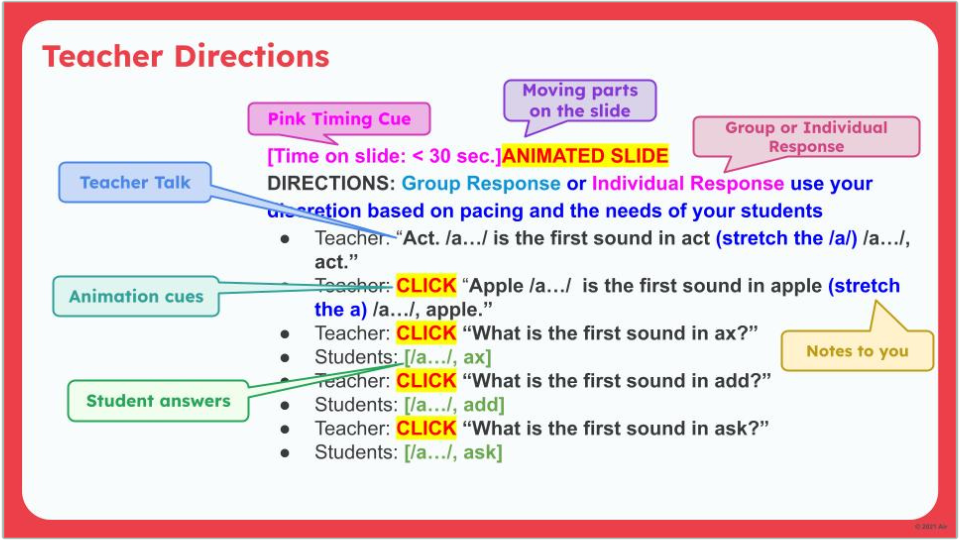
As you read the Teacher Directions, you might keep the following notes and recommendations in mind:
- Be familiar with what you should be saying. The “DIRECTIONS” section tells you what to say as you move through the slide. Teacher talk is always in BOLD, BLACK font.
- Watch for animations and practice in “Presenter View” BEFORE teaching.
- If a slide has moving parts or animation, it will be indicated at the top of the teacher directions in bold red font, highlighted in yellow: ANIMATED SLIDE!
- The word [CLICK] indicates you are to click your mouse to activate the slide animation. By following the Teacher Directions closely, you can time your speaking to the slide animation, providing your students with a positive, interactive learning experience.
- Please follow the pink timing cue, [Time on slide] indications. You will see timing guidelines written on many slides in the lower levels. We recommend following these timing cues to support the lesson's intended pacing. If you take more time than is written, you will not cover all the slides and will not finish the lesson within the class time. Many slides are intended to be viewed very quickly. Students will see the content either over a full level or across several lessons, and they will not be expected to master on the first try.
- Words in BOLD, BLUE font are additional teacher directions that are not read aloud to the students.
- Most slides ask for Group Response (all students respond simultaneously). If a response is to be individual, the slide will indicate Individual Response. Please note that students should read aloud for all response types.
- Suggested student answers are always in GREEN. Students do not need to answer precisely as written. These answers are there to help you if you need them.
Letter and sound pronunciation guidelines
- Capital + lowercase letter (e.g., Aa) = say the letter name: “A”
- Letter between slashes (e.g., /b/) = say the letter sound: /b/
- Vowel teams = say the long vowel sound (its name):
- /ay/ = long A
- /ee/ = long E
- /ie/ = long I
- /oe/ = long O
- /ue/ = long U
- Single vowels alone = say the short vowel sound:
- /a/, /e/, /i/, /o/, /u/
- Other spellings reflect the sound directly (e.g., /uh/, /ih/, /tl/, /bl/)
| Go back | Click here to go to Part 4 |
Was this article helpful?
That’s Great!
Thank you for your feedback
Sorry! We couldn't be helpful
Thank you for your feedback
Feedback sent
We appreciate your effort and will try to fix the article