
Getting Ready to Teach - Part 6: Assessment
Last updated: April 23, 2026
At Air Reading, we use a variety of tools to assess and monitor student growth. This article provides a brief introduction to the different types of assessments used at Air Reading, along with links to full articles on these topics for a more detailed discussion.
Table of contents
- Grade Level Assessment
- Diagnostic Assessment
- Daily Mastery Check
- 6th Lesson Assessments: Progress Monitor
- Error count guidelines
Grade Level Assessment
The Grade Level Assessments are administered at the beginning of a cohort as part of the Diagnostic Assessment and then monthly throughout a student's time with Air Reading. The purpose is to measure student growth over time at their grade level.
Important: The Grade Level assessments are difficult for many students, especially if their reading level is below grade level. Keep the tone positive and supportive. Encourage students to try their best and acknowledge the challenge.
What to expect: Students will read a passage at their grade level for one minute. Record the total number of words read, the number of errors, and whether the student was able to retell the passage (if applicable).
For a full explanation of when and how to administer this assessment, please visit the article, Grade Level Assessment.
Diagnostic Assessment
The Diagnostic Assessment is given during the first class of each new cohort. It helps determine the appropriate starting level in our curriculum for each student.
What to expect: First administer a Grade Level Assessment for each student in the class, followed by the Diagnostic Assessment (DA). Depending on the grade level of the student, on the DA they will be asked to read letter names and letter sounds (K-2 only) and/or word lists (all grades). Carefully record incorrect letters, sounds, and words in the Teacher Portal and follow the guidelines in the Teacher Directions to know when to stop administering the assessment.
Watch the video to see what the administration of the Diagnostic Assessment may look like.
For a full explanation of how to administer this assessment, please visit the article, Diagnostic Assessment. Please note that the recording of this video was taken prior to teaching on the Teacher Portal, so the interface may look slightly different, but the content and administration of the Diagnostic Assessment remain the same.
Daily Mastery Check
Every lesson in the Air Reading curriculum includes a Mastery Check to assess students' understanding of new concepts and retention of previously covered material. This assessment helps monitor student progress daily and provides important data to guide instruction.
What to expect: You can easily identify the Mastery Check portion of the lesson by the orange borders around the slides.
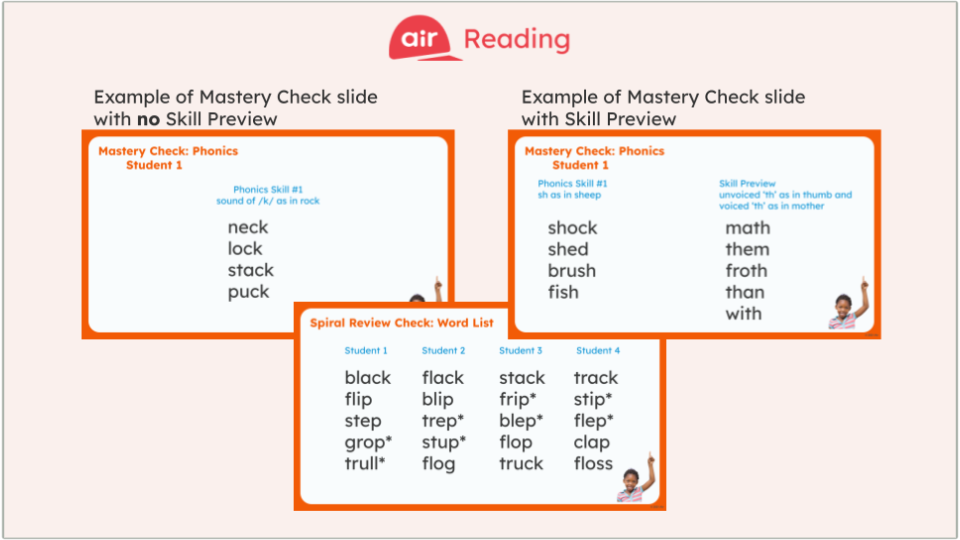
For a full explanation of how to administer this assessment, please visit the article, Daily Mastery Check.
6th Lesson Assessments: Progress Monitor
Every 6th lesson in the Air Reading curriculum includes a Progress Monitor assessment. This check-in helps evaluate student retention of material over time and provides valuable data to identify students who may need additional support.
What to expect: Depending on the level, the content of the Progress Monitor assessment is as follows:
- Phases 0–2: Students read letter sounds and a word list.
- Phases 3–7: Students read a fluency passage.
Students will read letter sounds for 30 seconds or the fluency passage for one minute and a word list (not timed). Keep track of how many errors are made and record the total number of sounds or words read as well as the number of errors. In phases 3-7, you will also indicate whether the student was able to retell the passage from the portion they read.
For a full explanation of when and how to administer this assessment, please visit the article, 6th Lesson Assessments: Progress Monitor.
Error count guidelines
Below is an outline for counting errors when administering assessments. Additional guidance may be found in the articles linked above or in the Teacher Directions for each specific assessment.
How to count errors
- Sounds:
- Incorrect sounds (e.g., /b/ for /d/) = error.
- Saying "puh" for /p/ (adding "uh") is not an error.
- Words:
- Misreading or taking longer than three seconds = error.
- Goal: Students must read words correctly within three seconds.
- Self-corrections (as long as they are corrected within three seconds) and repetitions are not errors.
- Note: You may encourage students to sound out a word by letter sounds, however, they must still read the word correctly within three seconds. Saying the sounds only is not considered a correct response.
- Paragraphs:
- Substitutions, skipping a word, or if they transpose the words (e.g., if the student says "the and" when it should be "and the," that would be two errors because there are two words).
- Self-corrections, insertions, and repetitions are not errors.
- Proper nouns are only errors the first time they are mispronounced.
- If a student loses their place or skips a line, you may pause the timer and point to the beginning of the line, but do not underline the entire passage.
| Go back |
Was this article helpful?
That’s Great!
Thank you for your feedback
Sorry! We couldn't be helpful
Thank you for your feedback
Feedback sent
We appreciate your effort and will try to fix the article