Why High-Dosage Tutoring Works
Last updated: December 1, 2025
High-Dosage Tutoring (HDT) is an intensive, evidence-based instructional model proven to accelerate student learning. Though it has roots dating back decades, it gained widespread adoption after 2022 as a key strategy to address learning gaps. As of June 2025, approximately 42% of American public schools offer this specific tutoring model [1].
Table of contents
- What is high-dosage tutoring?
- Proven effectiveness: research & real-world results
- Additional positive impacts
- Sources cited
What is high-dosage tutoring?
HDT is an intensive, relationship-based, and highly individualized intervention model characterized by specific design principles that distinguish it from general or peer-tutoring programs. The EdResearch for Recovery project [2], co-led by education policy experts from the University of Virginia and the Annenberg Institute at Brown University, identified the following key design principles that support a high-quality program.
Key design principles
The table below outlines several key design principles for high-quality HDT as outlined in the EdResearch for Recovery project referenced above, as well as how Air Reading incorporates and addresses these principles.
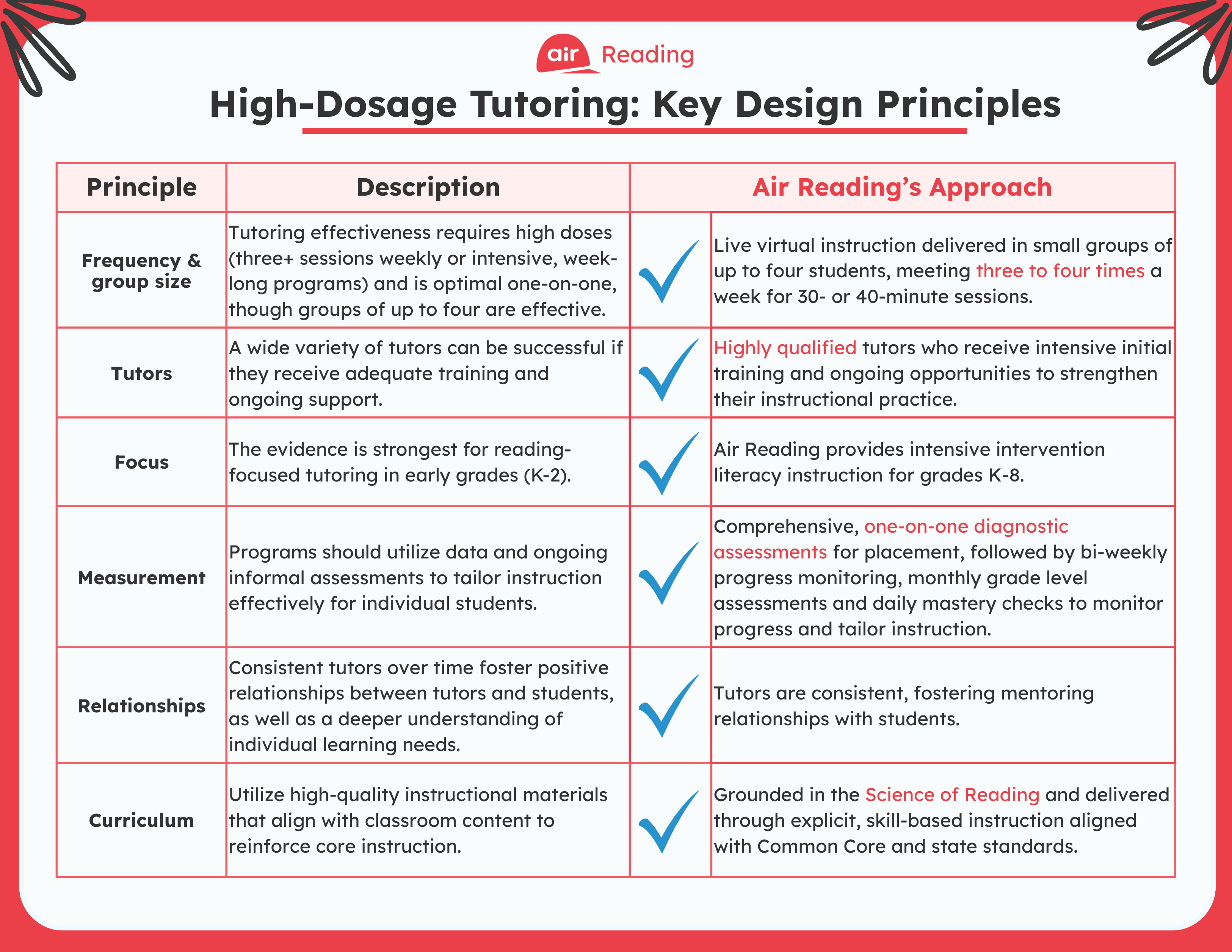
Click here for the downloadable PDF of the above table: High-Dosage Tutoring: Key Design Principles.
Proven effectiveness: research & real-world results
HDT is highly effective across grade levels, with both research and school leaders confirming its powerful impact on student learning outcomes.
Research findings
- Demonstrated positive effects: A review of almost 200 studies indicates that HDT is at least 15 times more effective than standard tutoring models for reading, and is one of the few school-based interventions with "demonstrated large positive effects [3]." It increases students’ learning by an additional 3-15 months across grade levels and moves an average student from the 50th percentile to the 66th percentile [4].
Increased effectiveness: The HDT model is up to 15 times more effective at improving students’ reading skills than other tutoring models [2].
Benefits for younger students: Because younger students have shorter attention spans, "short bursts" of HDT can be highly effective [5].
Meaningful long-term effects: One-to-one HDT is more effective than other reading interventions (including small group and computer-assisted instruction) for students reading below grade level, with its benefits, such as those from phonics instruction, lasting into the upper elementary grades [6].
What school leaders say
Effective: School leaders overwhelmingly support HDT. Over 80% of public schools reported offering some type of tutoring program for the 2023-2024 school year. Of the schools providing high-dosage tutoring, about three-quarters reported that the program was moderately, very, or highly effective [7].
Reading growth: Districts implementing HDT have reported large leaps in reading growth. Some Air Reading partners have seen significant growth in students’ scores. A few examples from our partner schools in Louisiana include:
Assumption Parish schools saw a 24.1% increase in students at or above grade level.
Bossier Parish schools in Louisiana saw a 22.8% increase in students at or above grade level.
Waller Elementary in Bossier Parish increased the number of students reading at grade level by 15 points, from 38% to 53%.
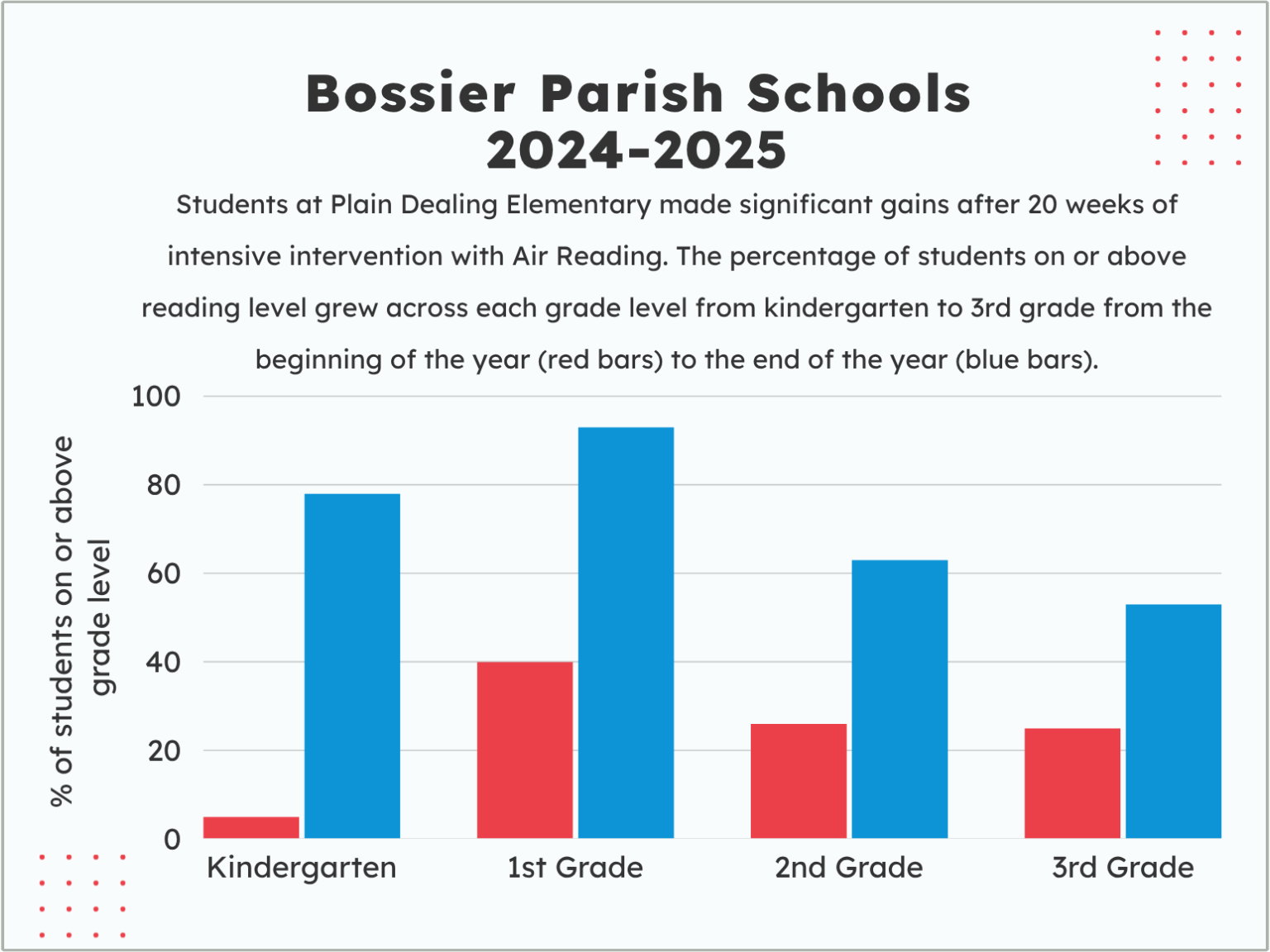
Plain Dealing Elementary in Bossier Parish showed consistent, impressive growth in grades K-3 during the 2024-2025 school year (see bar graph below).
Additional positive impacts
Beyond academic growth, HDT has been shown to:
Improve student attendance: HDT has been shown to reduce student absenteeism by up to 7% [8].
Promote equity: By providing HDT during the school day, schools can improve student equity, removing barriers (such as transportation or cost of hiring a private tutor) that would otherwise prevent students who could benefit most from receiving targeted instruction [9].
Sources cited
- National Center for Education Statistics. (2025, June). School Pulse Panel: Interactive results (Tutoring data from June 2025 survey). U.S. Department of Education, Institute of Education Sciences. https://nces.ed.gov/surveys/spp/results.asp#tutoring-jun25-chart-1
- Robinson, C. D., Kraft, M. A., Loeb, S., & Schueler, B. E. (2021). Accelerating student learning with high-dosage tutoring. EdResearch for Recovery Project. (ERIC Document Reproduction Service No. ED613847). https://files.eric.ed.gov/fulltext/ED613847.pdf.
- National Student Support Accelerator. (n.d.). Research: Overview of the Field. Stanford University. https://nssa.stanford.edu/research/to-date.
- Pearce, A., & Shoemaker DeMio, P. (2024, January 18). Scaling up high-dosage tutoring is crucial to students’ academic success. Center for American Progress. https://www.americanprogress.org/article/scaling-up-high-dosage-tutoring-is-crucial-to-students-academic-success/.
- Stanford Graduate School of Education. (n.d.). Short bursts of tutoring improves young readers’ skills in only minutes a day, Stanford study finds. Retrieved from https://ed.stanford.edu/news/short-bursts-tutoring-improves-young-readers-skills-only-minutes-day-stanford-study-finds#:~:text=A%20study%20by%20Stanford%20researchers%20finds%20that%20%E2%80%9Cshort%20bursts%E2%80%9D%20of,helping%20children%20learn%20to%20rea.
- Davis, S., Lake, C., Madden, N.A., and Slavin, R.E. (2009). Effective Programs for Struggling Readers: A Best Evidence Synthesis. (ERIC Document Reproduction Service No. ED527634). https://files.eric.ed.gov/fulltext/ED527634.pdf.
- National Center for Education Statistics. (2024, May). School Pulse Panel: Interactive results (Tutoring data from May 2024 survey). U.S. Department of Education, Institute of Education Sciences. https://nces.ed.gov/surveys/spp/results.asp#tutoring-may24-chart-4.
- Taylor, S. K. (2024, March 22). High-dosage tutoring boosts student attendance, Stanford research finds in D.C. schools. Chalkbeat. https://www.chalkbeat.org/2024/03/22/high-dosage-tutoring-boosts-student-attendance-stanford-research-dc-schools/.
- Dynarski, S. M., Seder, S., & The Education Policy Analysis Archives. (2010). Supplemental Education Services Under No Child Left Behind: Who Signs Up, and What Do They Gain? Journal Article. Education Policy Analysis Archives, 18(9). https://journals.sagepub.com/doi/abs/10.3102/0162373710361640?journalCode=epaa.
Was this article helpful?
That’s Great!
Thank you for your feedback
Sorry! We couldn't be helpful
Thank you for your feedback
Feedback sent
We appreciate your effort and will try to fix the article