Research Shows That Air Reading Leads to Measurable Gains in Literacy
Last updated: March 5, 2026
Air Reading's virtual tutoring model has been rigorously evaluated in two Randomized Controlled Trials (RCTs)—widely regarded as the gold standard of educational research—by the Johns Hopkins University Center for Research and Reform in Education (CRRE). The most recent study, published in February 2026, as well as a prior study, published in September 2024 confirm that students who participate in Air Reading’s program achieve measurable, statistically significant gains in reading achievement.
Table of contents
February 2026: Study overview
This study represents the second randomized controlled trial (RCT) conducted on our program. Our first RCT showed statistically significant, positive outcomes. This second, larger RCT confirms those findings, with Air Reading achieving the strongest randomized trial results published so far for virtual reading tutoring across an even larger and more diverse group of students and school settings.
| Purpose | To evaluate the effectiveness of Air Reading’s live virtual tutoring initiative in improving reading skills among elementary students in Louisiana and Texas. |
| Design | A randomized controlled trial (meeting What Works Clearinghouse standards) was conducted in a large suburban Louisiana district and a rural district in Texas during an entire school year (2024-2025). |
| Participants | 377 students identified as performing below grade level, representing a diverse population and including:
|
| Comparison | Students were randomly assigned to either the Air Reading treatment group or the "business-as-usual" control group, which received standard classroom instruction and literacy supports. |
| Tutoring model | Small groups of up to four students received 30-minute virtual sessions four times per week throughout the school year, delivered by a consistent, highly qualified tutor. |
How student progress was measured
Student achievement was measured using state-approved literacy assessments:
- Texas: TPRI (grades 1-2) and STAAR (grade 3)
- Louisiana: DIBELS (grade 2) and LEAP (grade 4)
*Student achievement was calculated by converting raw scores into a standard scale that allows scores from different assessments to be compared to each other.
Key findings
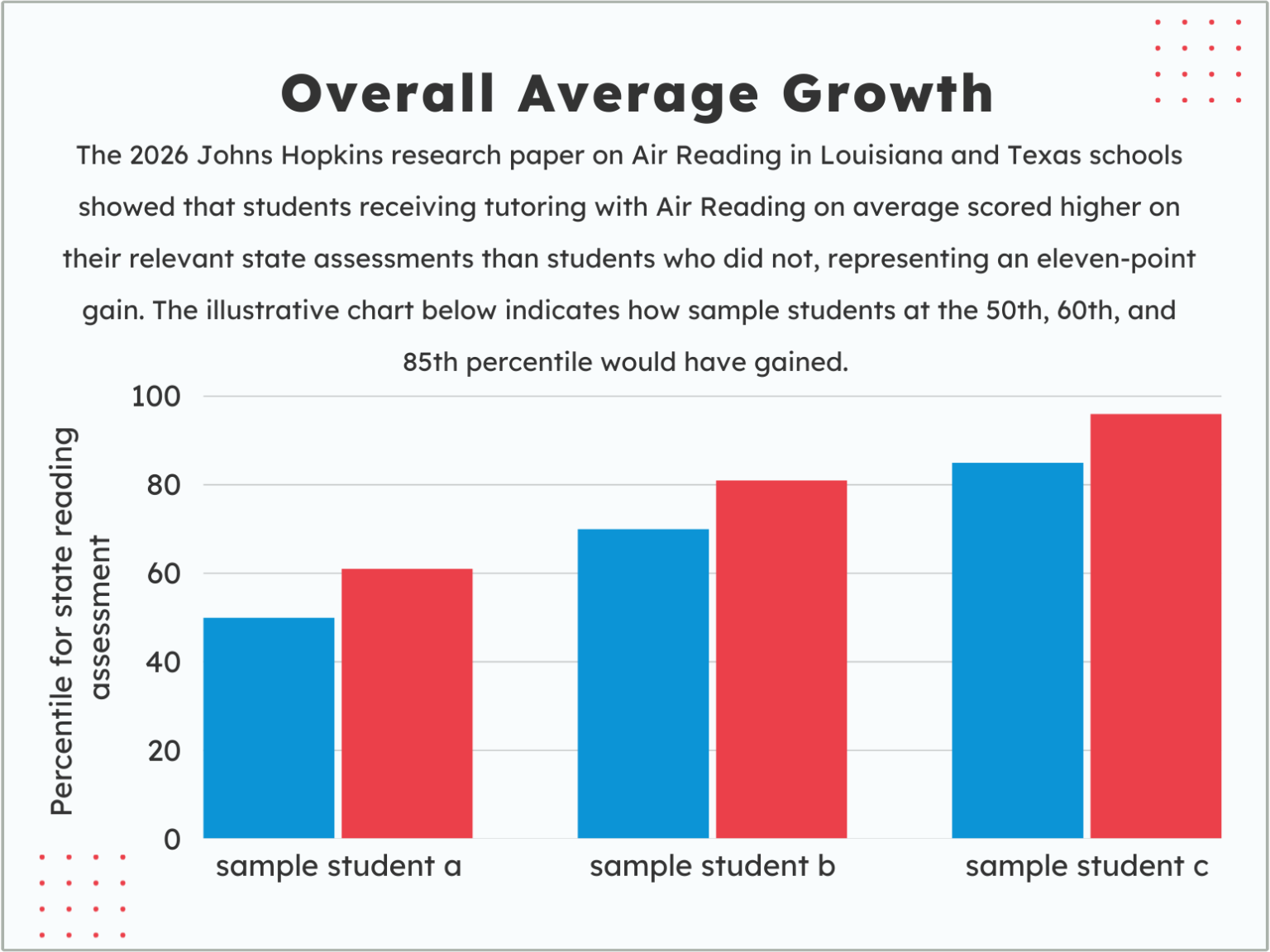
- Overall improvement: Air Reading students scored significantly higher on their state-approved literacy assessments than the control group, with an effect size of +0.29. This represents an estimated 2.8 months of additional learning and an improvement index of 11. For example, a typical student in the control group at the 50th percentile would have increased to the 61st percentile after participating in the program.
- Strength of results: Going beyond our first RCT in one district, which showed positive student growth with an effect size of +0.12, this second RCT across two districts reflected a substantially stronger effect size of +0.29.
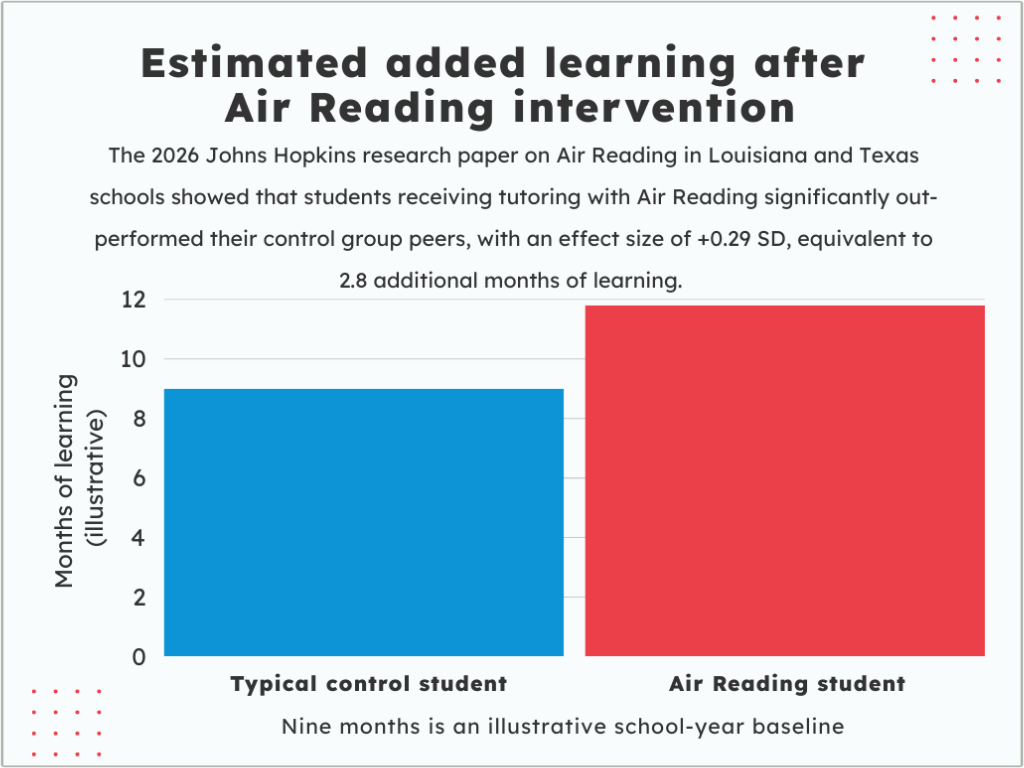
- Estimated added learning: This level of impact is equivalent to about 2.8 months of additional literacy learning.
- Consistent results: Growth was consistent across diverse student groups, including multilingual learners, economically disadvantaged students, and students in both rural and large, diverse school communities.
Conclusion for the February 2026 study
This second RCT marks an important milestone and demonstrates that the meaningful gains first observed in our initial RCT are sustainable at a larger scale and across varied school contexts. The results of the study demonstrate that Air Reading's consistent, systematic model significantly enhances the reading skills of students performing below grade level. Its scalability and adaptability make it a promising, evidence-based model for addressing literacy challenges across diverse educational contexts.
September 2024: Study overview
| Purpose | To evaluate the impact of Air Reading's Science of Reading-based virtual tutoring program on elementary students performing below grade level. |
| Design | Randomized controlled trial (meeting What Works Clearinghouse standards) conducted in six rural Texas schools during the spring of 2024. |
| Participants | 381 students (grades 1-6) identified as needing additional reading intervention (Tier 2 or Tier 3). |
| Comparison | Students were randomly assigned to either the Air Reading treatment group or the "business-as-usual" control group, which received standard classroom instruction and literacy supports. |
| Tutoring model | 40-minute virtual sessions, four times per week, in small groups (up to 4 students) with consistent, highly-qualified tutors. |
Key findings
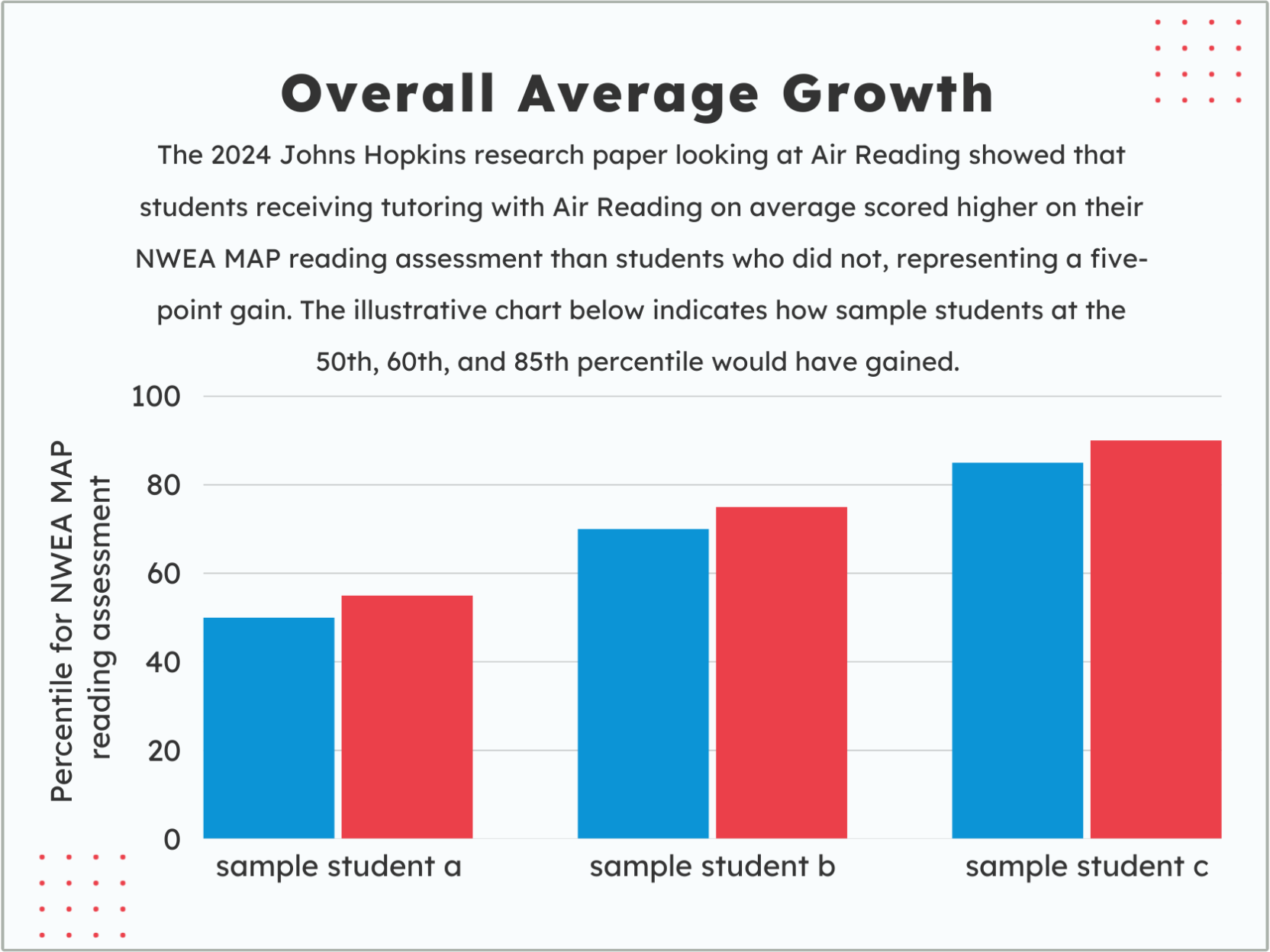
- Overall improvement: On average, Air Reading students scored significantly higher on the NWEA MAP* reading assessment than comparable peers, representing a five-point gain. For example, a student at the 50th percentile without Air Reading’s program would have increased to the 55th percentile if they had participated in it.
*NWEA MAP stands for the Measures of Academic Progress assessment that the Northwest Evaluation Association administers. Schools and districts use it to measure and track student achievement in reading, math, and language over time.
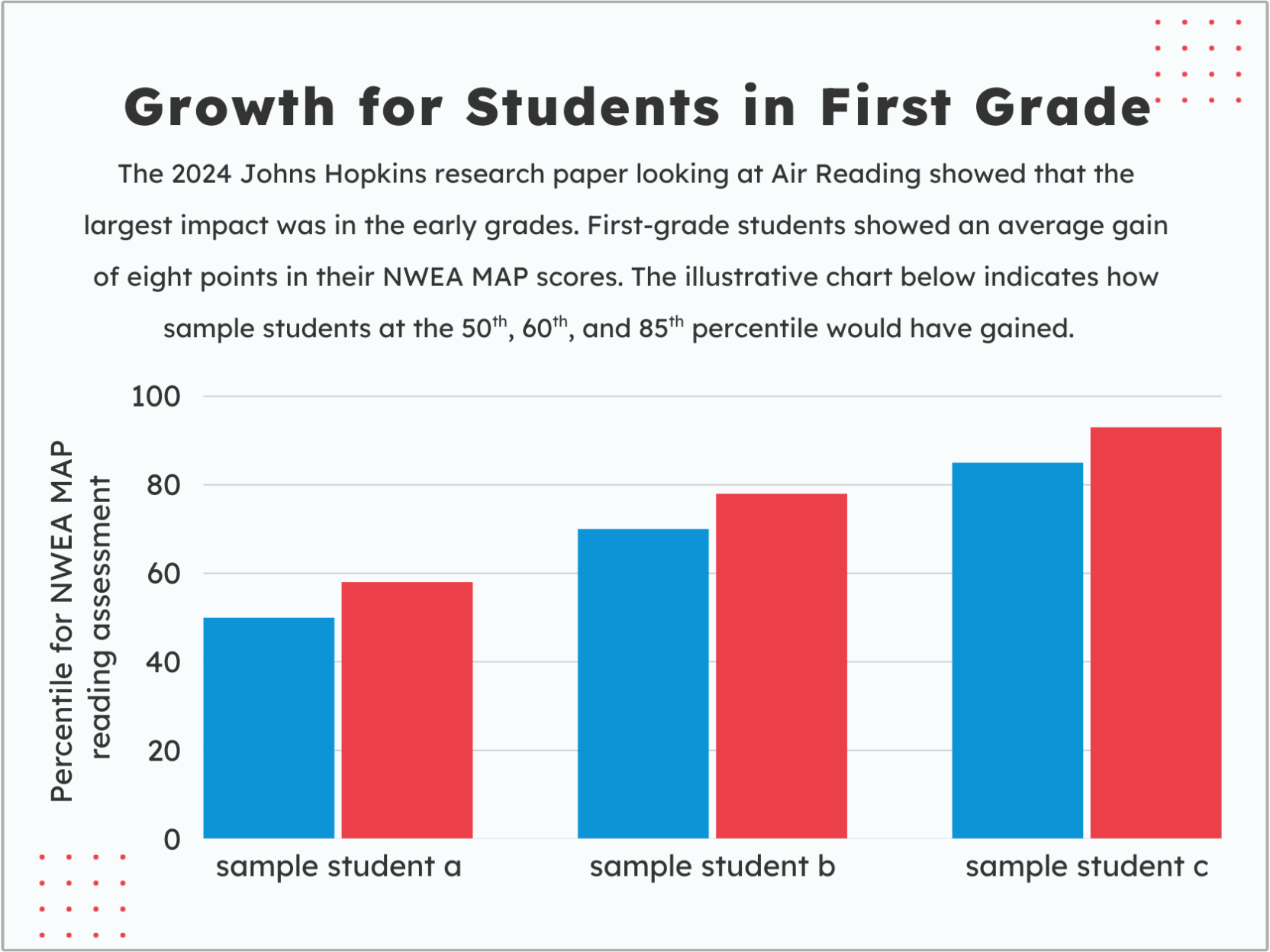
- Biggest impact: The most substantial impact occurred in the early grades; for first-grade students, the effect was larger, amounting to approximately an 8-point gain. For example, a first-grade student at the 50th percentile without Air Reading’s program would have increased to the 58th percentile if they had participated.
Conclusion for the September 2024 study
The Johns Hopkins evaluation demonstrates that Air Reading significantly improves reading outcomes for students below grade level, equivalent to 1.5–2 months of additional learning in a single semester. Its consistent structure, Science of Reading foundation, and scalability make it a promising, evidence-based model for addressing literacy challenges through virtual instruction.
Sources
Neitzel, A. J., & Storey, N. (2024). Air Reading: A randomized evaluation of a virtual tutoring model. Center for Research and Reform in Education, Johns Hopkins University. https://jscholarship.library.jhu.edu/server/api/core/bitstreams/e5e4e033-2416-436c-a1db-6c7ec02f633a/content.
Neitzel, A. J., Storey, N. & Wang, X. (2026). Air Reading: A randomized evaluation of a virtual tutoring model in Louisiana and Texas schools. Center for Research and Reform in Education, Johns Hopkins University. https://jscholarship.library.jhu.edu/server/api/core/bitstreams/922bff64-84b0-4f56-9f07-2d4a534619f9/content.
Was this article helpful?
That’s Great!
Thank you for your feedback
Sorry! We couldn't be helpful
Thank you for your feedback
Feedback sent
We appreciate your effort and will try to fix the article